AI Babysitter or Engineering Director?
ARTICLE 4 · AI DEVELOPMENT · DELEGATION · HUMAN APPROVAL
Stop prompt-engineering in circles. Start directing a controlled development workflow.
If your daily development routine has become endless prompt tweaking, you are not alone.
You spend your time:
- Typing long instructions.
- Re-explaining architectural decisions.
- Copying error traces between tools.
- Correcting changes outside the intended scope.
- Manually organising tasks and progress notes.
The AI generates code quickly, but you still carry the coordination work.
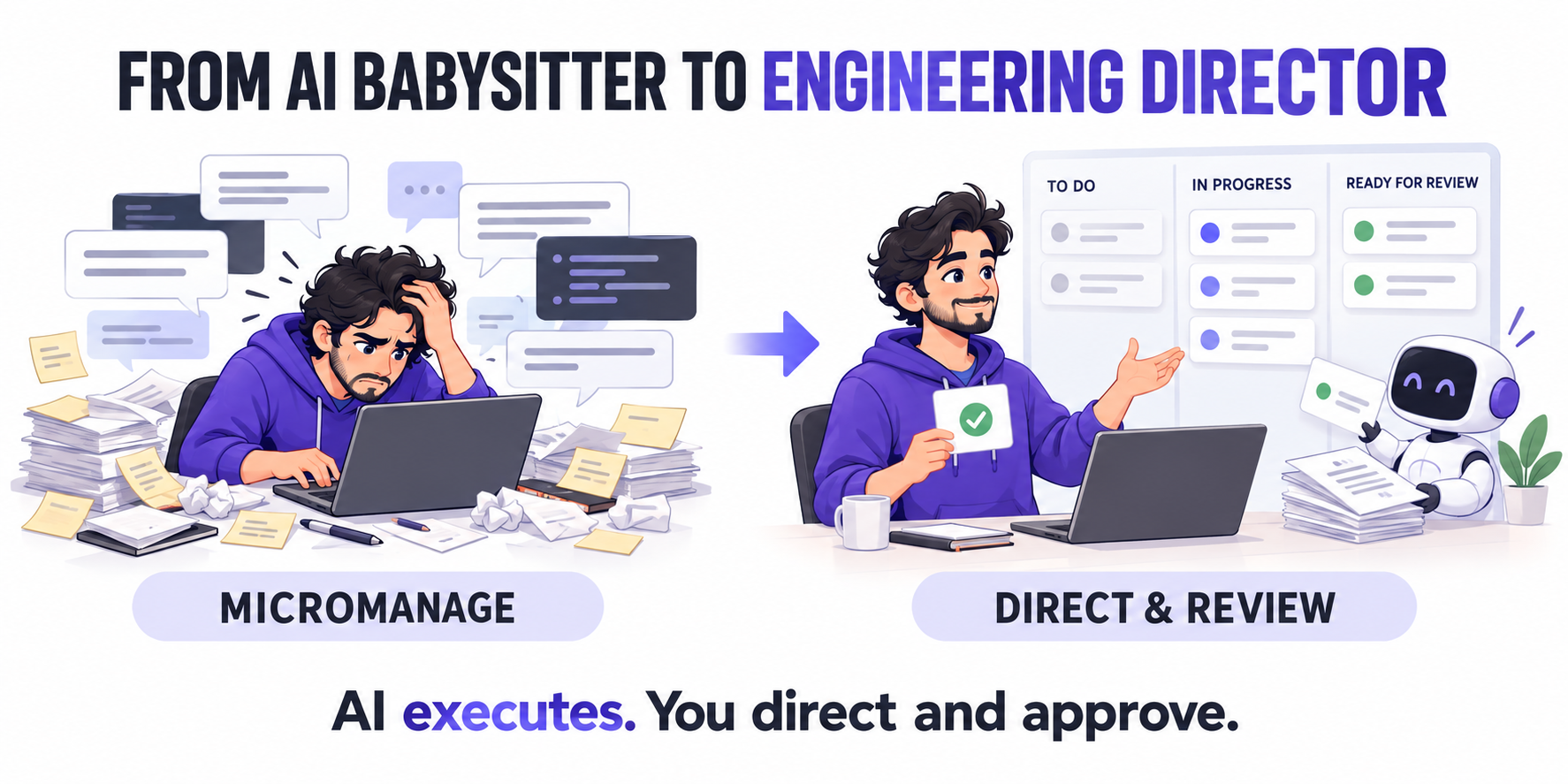
The High-Speed Typewriter Trap
Many developers use AI as a high-speed typewriter.
They sit in front of a chat box, micromanage implementation, and handle project administration by hand.
It is exhausting, repetitive, and leaves less time for engineering judgment.
Warning
Faster code generation does not automatically mean a better development workflow.
If every task depends on repeated explanations and manual tracking, you remain the bottleneck.
There is a better division of work.
It starts with a shift: from writing every instruction in the moment to directing work through clear specifications, bounded tasks, and review gates.
What Does an Engineering Director Do?
An Engineering Director defines the intended outcome, establishes boundaries, and decides whether the result meets the required standard.
The AI helps execute the work and maintain its supporting records.
You remain responsible for:
- Direction: What the software should achieve.
- Architecture: Which patterns and constraints guide implementation.
- Priorities: What should be built next.
- Quality: What evidence is sufficient for approval.
Important
Delegating execution does not mean delegating accountability.
The AI can propose, implement, and document. You retain authority over scope, architectural decisions, and final acceptance.
The Human–AI Division of Work
AI can help with implementation, planning, and documentation. Human review keeps that work aligned with the project's goals.
| Task category | AI: execution and administration | Human: direction and quality |
|---|---|---|
| Requirements | Identifies ambiguities, suggests edge cases, and drafts specifications | Validates business needs and approves the written specification |
| Task planning | Drafts task cards and proposes dependency order | Reviews scope, priorities, and milestones |
| Implementation | Writes code for bounded tasks | Reviews changes and architectural fit |
| Documentation | Drafts engineering journals and Git summaries | Checks accuracy and unresolved issues |
| Verification | Runs available checks and records evidence | Evaluates coverage, limitations, and runtime behaviour |
| Final sign-off | Submits the task for review | Approves the result before it moves to Done |
Give Each Role a Clear Boundary
The AI should know what it can execute independently and what requires a decision.
For example:
- It can draft a backlog, but you approve its scope.
- It can implement an approved task, but scope expansion requires review.
- It can summarise a Git diff, but the summary must match the actual changes.
- It can report passing checks, but you decide whether they are sufficient.
This makes delegation easier to supervise.
Delegate Tracking and Documentation
Moving into the Engineering Director role reduces the need to write every task card and progress entry yourself.
The workflow still needs clear instructions, access to the relevant tools, and review.
1. Turn an Approved Specification Into a Backlog
Once you approve the specification, ask an AI planning assistant to translate it into actionable tasks.
Each card should include:
- Objective: The outcome the task must produce.
- Scope: What may be created or modified.
- Exclusions: What must remain unchanged.
- Dependencies: What must be completed first.
- Acceptance criteria: How completion will be verified.
The number of cards should reflect the project. A small feature may need only a few; a larger application may need dozens.
Your job is to review the plan—not type every card from scratch.
Tip
Review the backlog before implementation begins.
Check for missing requirements, oversized tasks, duplicated work, and incorrect dependency assumptions.
2. Make Journaling Part of Task Completion
After implementation, the coding agent can inspect the Git diff and available verification outputs to draft an engineering journal entry.
A useful entry records:
| Journal field | What it explains |
|---|---|
| Implementation | What changed and which files were affected |
| Decisions | Why the chosen approach was used |
| Verification | Which checks ran and what they showed |
| Limitations | Which checks were blocked or incomplete |
| Next action | What remains to be done |
Documentation becomes part of the delivery process, rather than a separate chore left until later.
Caution
Generated documentation needs evidence.
The agent should report actual changes and results, without claiming that unperformed checks passed.
3. Keep the Human Approval Gate
When the task is ready for review, inspect the result against its acceptance criteria.
Depending on the change, this may include:
- Reviewing the Git diff.
- Exercising the feature manually.
- Inspecting application and background-worker logs.
- Checking test results and unresolved failures.
- Confirming that the implementation respected its boundaries.
Only then approve the task as complete.
Important
The agent can recommend completion.
In this workflow, the human reviewer holds the authority to move the task to Done.
A More Focused Development Routine
The difference becomes visible in how you spend your time.
| Instead of repeatedly… | You focus on… |
|---|---|
| Re-explaining architecture | Maintaining clear repository rules |
| Writing every task manually | Reviewing an AI-generated backlog |
| Reconstructing progress from chats | Reading persistent task records |
| Drafting every change summary | Checking evidence-backed journal entries |
| Accepting “task complete” at face value | Reviewing results against acceptance criteria |
You still intervene when judgment is needed. Routine coordination becomes easier to delegate.
Direct the Work. Review the Evidence.
You did not become a software engineer to spend your day copying error messages between chat windows or rewriting task lists.
Use AI to help with backlog generation, bounded implementation, and change documentation.
Keep your attention on the decisions that shape the product:
- What should be built.
- How it should fit the architecture.
- Which risks need investigation.
- Whether the result is ready to accept.
The goal is to make each task easier to delegate, inspect, and approve.
Note
Ready to Become an Engineering Director?
The Card-Driven AI Development Playbook provides the human–AI division of work, task templates, and prompt kits to help you build a controlled development workflow.